Triogger Wordpress to Upgrade Database Again
The WordPress database provides the foundation of your WordPress website. Without a database, your WordPress website simply couldn't function. The WordPress database powers your website to load and run, plus stores and saves the content of your blog, such as posts and comments, plus the changes that you (or fifty-fifty your visitors) make.
In this article, we're going to look at what the WordPress database is and how information technology works. By the end of this postal service, you'll have a much more thorough understanding of the data that drives your WordPress website. Let'south dive in.

Does WordPress Accept a Database?
As y'all probably already figured out, yes, WordPress requires a database. WordPress is a database-driven, open-source content management system or website platform, written in PHP. WordPress uses a database to store and retrieve the content of your website or blog.
Essentially, a WordPress website is "a friendly face on a database."
WordPress uses the MySQL database direction system. If you're non familiar with MySQL, it an open-source relational database management system (RDBMS) that is commonly used to create databases. MySQL uses Structured Query Language (SQL), a popular language for databases. MySQL works best with other open-source applications like WordPress, Apache web server, the Linux operating arrangement and PHP.
Before you can install the WordPress software, you outset demand to have a MySQL database. When looking for a hosting provider for WordPress, you'll notice that all of them have MySQL already included in their packages. During installation, you provide WordPress with the data near your specific database and WordPress sets up the residual.
Well-nigh WordPress users volition never need to interact with the WordPress database. Information technology but operates behind the scenes. But information technology's helpful to sympathize what the WordPress database is and how information technology works if you lot're interested in theme or plugin development or contributing to WordPress cadre.
What Is the WordPress Database?
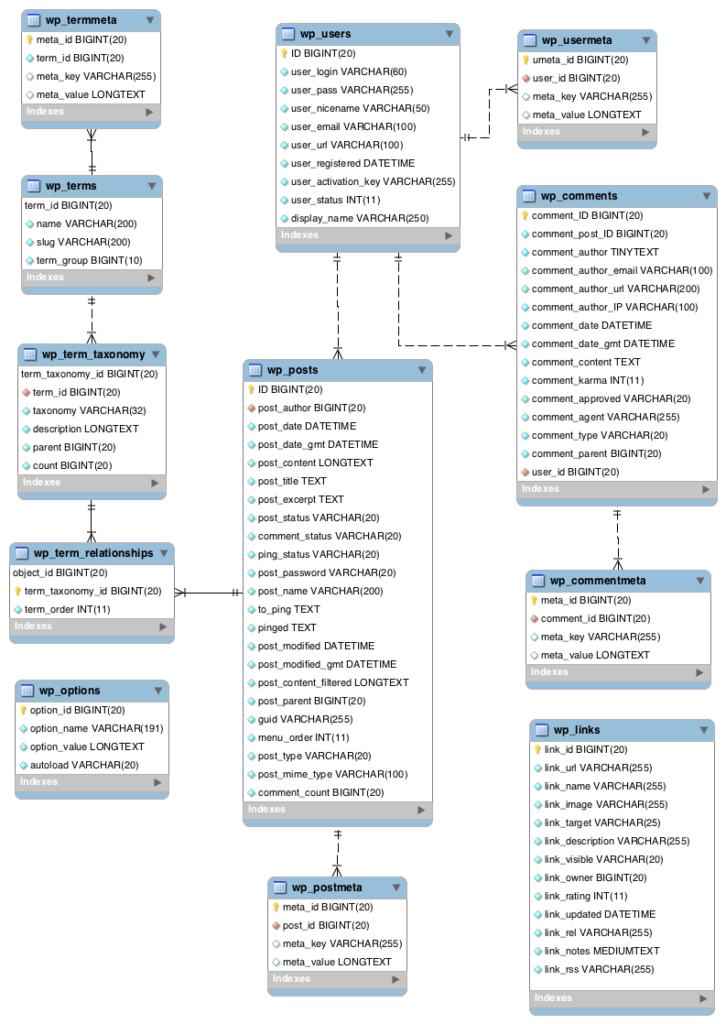
The WordPress database is a MySQL database that stores your website'southward data into tables, rows and columns. The WordPress database is dynamic, which ways yous can add, modify and delete information contained inside it (provided that you have administrative access).
Hither's more on the WordPress database description.
Get the bonus content: A Guide to WordPress Security
Why Does WordPress Need a Database?
More often than not speaking, every WordPress site consists of a lot of different information types. All of this data has to be stored somewhere. That is where the WordPress database comes into play.
The database concept is not unique to the WordPress platform. A database tin can be simple or complex. Information technology tin can be small or large. But what all databases have in common is that they store information in a way that's fast and elementary to access.
Some examples of the different types of data that is stored in the WordPress database include:
- Pages, posts and boosted content
- Tags, categories and other organizational information
- User comments and contour data
- Theme and plugin-related data
- Full-site settings
It's easy to see how nearly everything that comprises your website is stored in the WordPress database. This alone is a practiced reason to learn more than most how the WordPress database works.
How Does the WordPress Database Role?
When you commencement install WordPress to create a new site, a database is created. Well-nigh often during WordPress installs, the database is created automatically. Withal, it's as well possible to manually create a database or use a database that already exists. Regardless whether information technology'due south automatically created or if you create 1 manually, your new database will exist stored on the server of your hosting provider (sometimes called a database host).
When a user lands on your website, their browser pings a request to the server of your site. The server sends that required data to properly display your site and allow it to piece of work for your users the way in which you intended.
Whatever database needs software to function. In the case of the WordPress database, that software management organization is called MySQL, an open-source software.
Considering the WordPress database uses the MySQL platform, y'all'll often hear the database for your site called the "MySQL Database." Just don't let that intimidate or misfile y'all. All that ways is that MySQL is what enables your database to store info and give you direct access to the data. When you demand to shop, delete or alter data, WordPress volition send a MySQL query to your database instructing it to perform the specific actions that you requested in the assistants console.
WordPress Database Structure
Without the MySQL platform, you wouldn't be able to admission the WordPress database. Think of MySQL as the engine that powers your database.
What data is stored in the WordPress database? And how exercise you find and access the database for your WordPress business relationship?
Let'southward look closer at the WordPress database structure, as well as the types of data and tables included in the database.
What Is Stored in the WordPress Database?
At the commencement of the article, we talked briefly about how the data within your WordPress database is organized. For gigantic amounts of data to be accessed hands and quickly, it gets organized into database tables.
Think of a database table as a folder inside of a large filing chiffonier. Each folder, or table, is organized into different specific categories of data.For example, the physical filing organisation in your home might include 1 folder for receipts and another for upcoming bills. Similarly, the WordPress database has different tables for posts, user comments, user data and so forth.

Default WordPress Database Tables
Every brand new WordPress database install will includes 12 tables. The names of the tables give you a pretty solid idea of what each table is responsible for storing.
Additionally, each tabular array will incorporate a variety of fields and columns that store even more specified bits of data. For example, the wp_comments tabular array has all of the data related to user comments on your posts and pages.
| Tabular array Name | Clarification |
|---|---|
| wp_users | The list ofusers on your WordPress website. Users of all WordPress user roles are stored here (administrator, editor, author, contributor, subscriber, etc.) Additional user data stored in this tabular array includes username, first proper noun, concluding name, nickname, countersign, email, registration engagement, condition and office. |
| wp_usermeta | Eachuser features information called themeta data. Metadata stored here includes a unique user ID, meta fundamental, meta value, and meta ID. These are all unique identifiers for users on your site. |
| wp_term_taxonomy | WordPress uses three types of taxonomies, including category, link, or tag. This tabular array stores the taxonomy associations for the terms. |
| wp_term_relationships | This table stores the relationships between posts, categories and tags. The clan oflinks to their respective categories are besides kept in this table. |
| wp_termmeta | Eachterm features data called themeta data and it is stored in wp_termmeta. |
| wp_terms | Thecategories for both posts and links and thetags for posts are plant within the wp_terms table. |
| wp_posts | The core of the WordPress data is theposts. This table stores the content of any post or page that you've published, including autosave revisions and post selection settings. Additionally, pages and navigation menu items are stored in this table. |
| wp_postmeta | Eachpost features information called themeta information and information technology is stored in the wp_postmeta. Some plugins may add their own information to this table. |
| wp_options | All settings prepare from the WordPress admin dashboard'southward Settings page are stored here. This includes all theme and plugin options. |
| wp_links | The wp_links holds data related to thelinks entered into the Links feature of WordPress.(This feature has at present been deprecated, only can exist re-enabled with the Links Manager plugin.) |
| wp_comments | All comments published to your site are stored hither, along with additional information about the annotate author (name, URL, IP address, e-mail address, etc.) |
| wp_commentmeta | Eachannotate features information called themeta data and it is stored in the wp_commentmeta, including comment ID number. |
Whatever WordPress database table can be expanded to reveal all the data stored within the table. Take the wp_comments tabular array, for example.
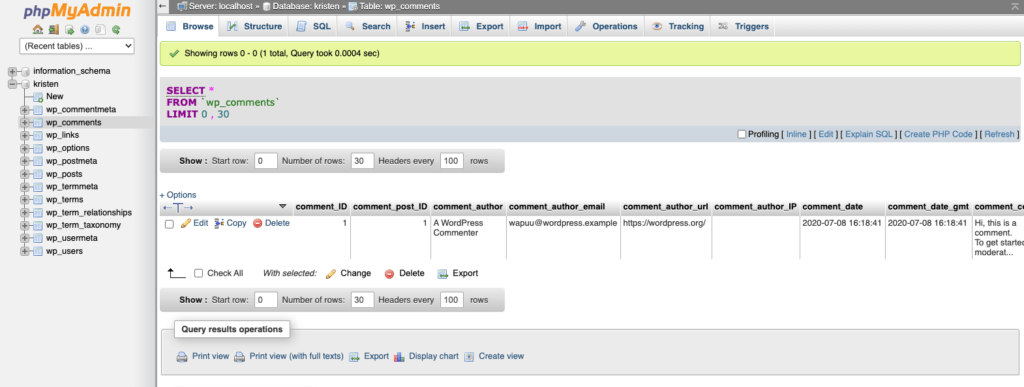
Every bit you lot can see, the WordPress database tables wp_comments is broken down even further into the these columns:
- comment_ID
- comment_post_ID
- comment_author
- comment_author_email
- comment_author_url
- comment_author_IP
- comment_date
- comment_date_gmt
- comment_content
- comment_karma
- comment_approved
- comment_agent
- comment_type
- comment_parent
- user_id
As y'all tin can see, your database stores a lot more than information well-nigh each user comment on your site than you probably idea. It stores info on each comment'due south author details, unique user ID, where the comment tin can be found, and much more.
How Do I Admission My WordPress Database?
Your WordPress database is mostly cocky-sufficient and regular users won't likely e'er need to admission it. For example, yous won't have to constantly access the database in order to run your site or create/alter site content. However, there are situations where it'southward important to know how to access and understand what'south within your database.
Some of the reasons you may want to access the WordPress database include:
- Learning and better understanding of how your website is structured
- Performing tasks that tin't be done in the WordPress dashboard
- Troubleshooting common errors in WordPress
You will also want to admission the WordPress database when you want to reset, repair or optimize your site to make it run faster. With these things in mind, let's have a look at how to access and manage the database.
phpMyAdmin
Recall how we mentioned that your database is stored on the server for your site? Because of this, you'll have to access your WordPress database via your hosting provider.
Depending on the hosting provider you lot're using, the process of accessing the database tin can vary a scrap. But in almost every case you lot'll access it through a utility that'southward called phpMyAdmin.
What is phpMyAdmin? phpMyAdmin is a complimentary software tool that allows you lot manage the MySQL database of your website.
cPanel is one of the most mutual web hosting command panels used by hosts, and then your web hosting dashboard will probably look something like this screenshot. As well note that if your host uses a unique, non-standard management system this process may be a flake dissimilar.
After logging in to your spider web hosting account's dashboard, you lot should have an option to open phpMyAdmin. Locate the phpMyAdmin icon within the Databases department of your cPanel control console.
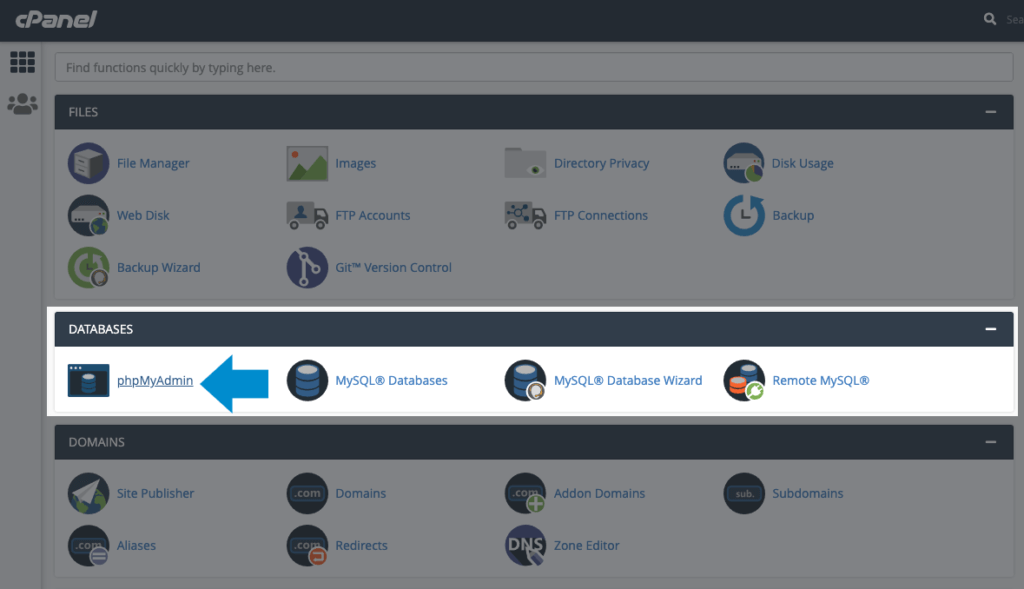
When you open phpMyAdmin, you'll run into a login screen. Here is where you'll enter your database username and password. This information is shown within the dashboard of the Database access section. You are now in the phpMyAdmin director.
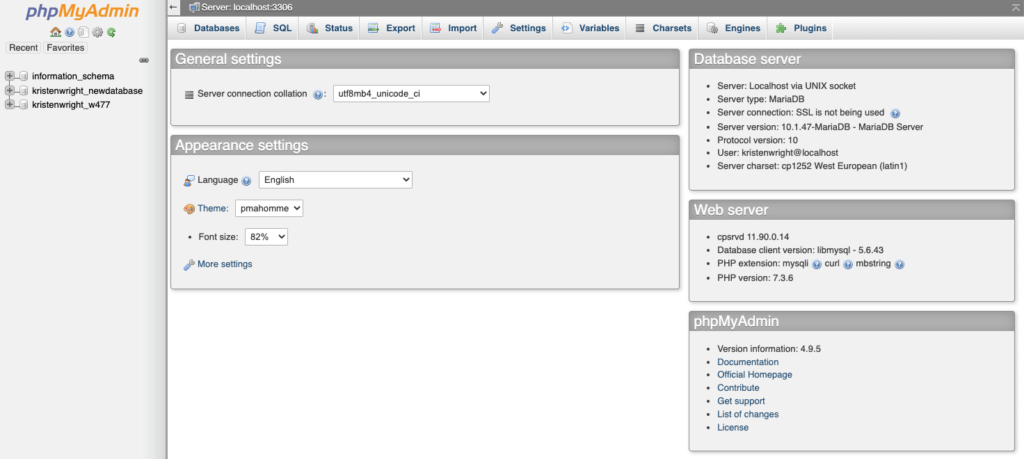
Accessing the WordPress MySQL Database and Making Changes
No matter what host you utilize to access it, phpMyAdmin will accept the same consistent look.
At the height of the screen, you'll see the "Databases" tab where y'all'll find a complete list of databases. You'll encounter a few that are related to phpMyAdmin and 1 that is named after your site.
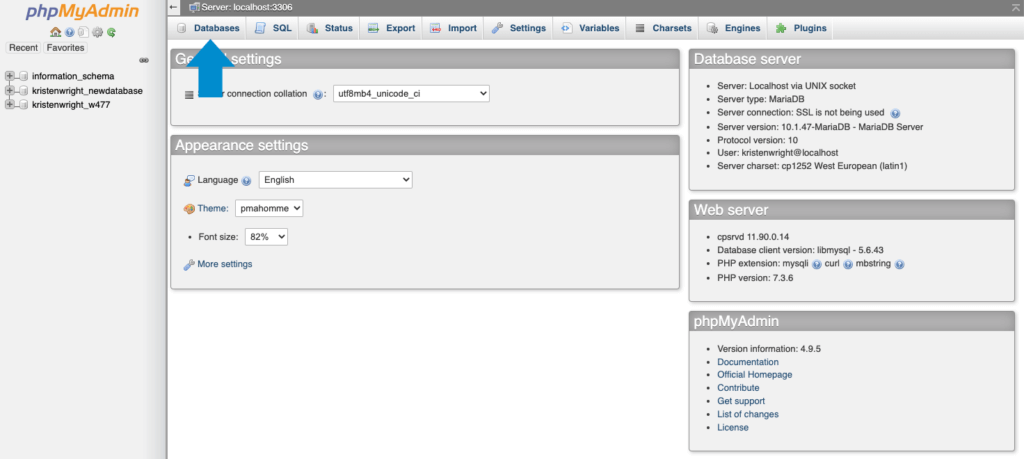
Click on the one named after your website and you'll see your website'due south total database. As you'll notice, this list includes the database tables detailed earlier in this article. You can access each one individually to see the fields and columns within it.
From this position, you lot can use the options to search for, change, delete or add information. For example, let's say that y'all desire to modify the username on your WordPress account. In that location's no way for you lot to do this in the WordPress dashboard, just it's quite piece of cake when you lot access the WordPress database.
All you lot demand to do is select the wp_users table, click on "Edit" next to the proper name y'all want to change and simply add the new username to the "Value" field that's under user_login.
When it's time to finalize the changes, select "Go." Your business relationship's username is now updated in WordPress.
A Word of Circumspection
As you dig into the WordPress database y'all'll find that a lot of tasks related to the database are simply every bit elementary as that. All that yous really need to do is locate the correct piece of information and make a uncomplicated change.
Nonetheless, information technology'south important to be careful when you lot brand changes. It's always a good idea to know the exact task y'all want to accomplish earlier you starting time. And then do a few searches for a tutorial or guide that'll show you where to find the data yous're looking for (and what you need to practice when you detect it).
Y'all can also search for plugins that aid you manage your database. There are quite a few costless options bachelor in the WordPress repository.
If yous don't consider yourself to exist a professional web developer, you might exist a petty intimidated by the thought of interacting with your database. Simply go along in mind that it's a job definitely worth learning.
When y'all learn nearly your database you'll be able to make more changes to your site than y'all thought were possible. And the majority of WordPress site hosts make information technology quite easy to access and manage the database. You'll go good at this faster than you lot might think.
How Practise I Create a WordPress Database?
The easiest way to create a WordPress database is by using the WordPress install functionality provided by your spider web host.
When y'all install a new application of WordPress, the MySQL database is created automatically without any required interaction from you. Notwithstanding, in that location are other times when you may want to create a new WordPress database manually.
There are a few different ways that you tin create a WordPress database on your own.
- The MySQL Database Wizard in your web hosting control panel. The fastest and easiest way to create a WordPress database is with the MySQL Database Wizard located in your spider web host's command panel (or cPanel).
- Through phpMyAdmin. The user interface isn't nearly as easy to use, simply database cosmos tin can happen in phpMyAdmin, if your user has privileges.
- Through the command line in MySQL (more on that later).
Here are a few of import tips to know earlier y'all create a new WordPress database.
- When naming your database, avoid using names that are predictable such as "mydatabase" or "blogdata." If there's a malicious attack and the user is trying to become into your database, it'll be more difficult for them if your proper noun is something that isn't quite so obvious.
- Keep in mind that y'all should as well avoid using usernames that are too predictable, like "blogger" or "admin."
- Utilize a strong password from a countersign generation tool or create one that has a minimum of viii characters, including letters, numbers and special characters. Avert using names or dictionary words every bit database user passwords. A skilful example of what a strong password should look similar is:
Once the new WordPress database is created and you've made a username and countersign to access it, you'll need to set the user privileges.
Creating a new WordPress database from the MySQL Database Sorcerer
Log in to your new hosting account to access cPanel. Note: your host may use a different hosting backend service other than cPanel, but the procedure volition be similar.
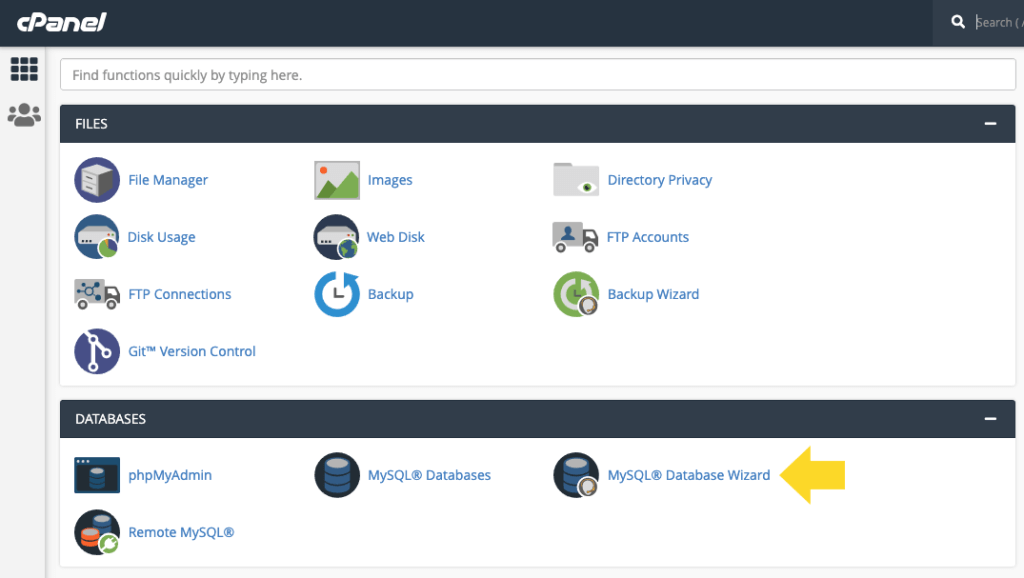
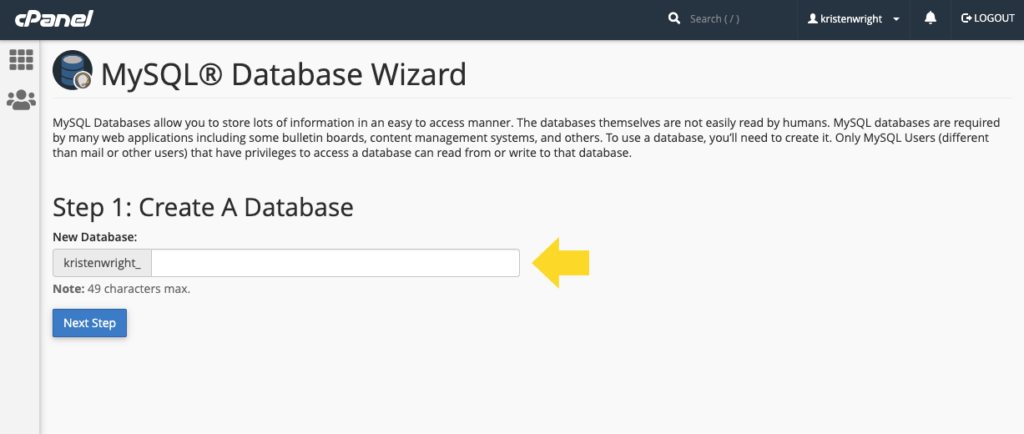
From cPanel, locate the MySQL Database Wizard icon in the list and click on it. The MySQL Database Sorcerer volition guide you through the next steps. Outset, add the name of the new database.Click "Next Step."
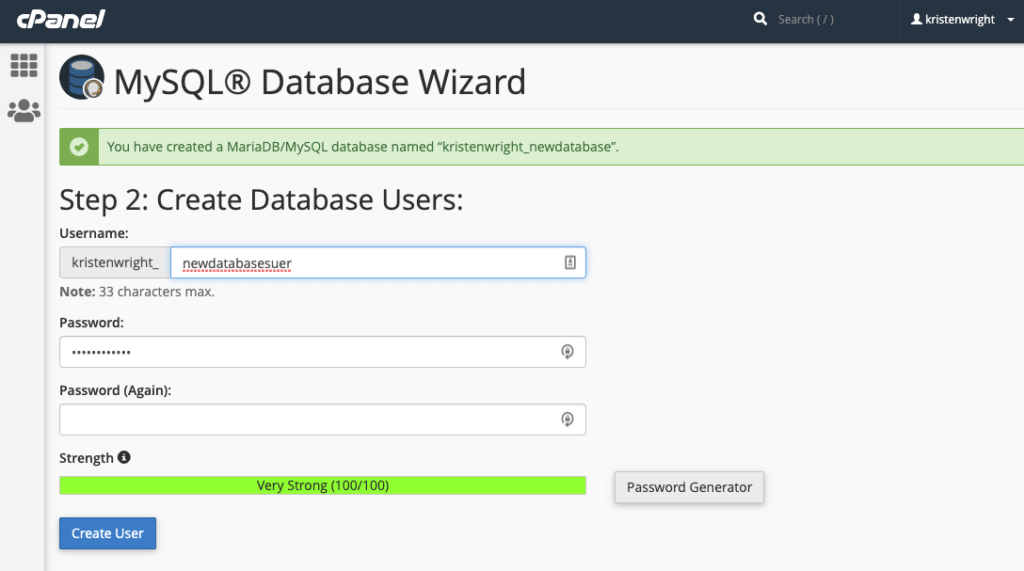
Next, add a database user. Use the password generator to create a strong countersign. Don't forget to copy the username and password y'all create hither to a secure location using a service like LastPass.Click "Create User."
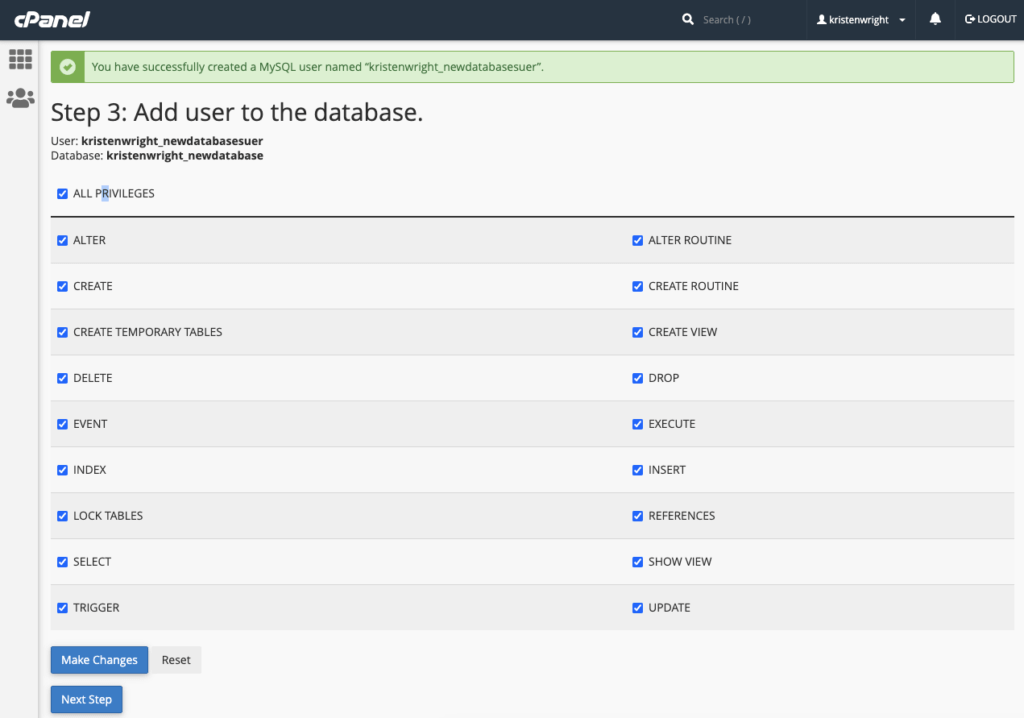
The next screen will add together the new user to the database. Click the "All Privileges" checkbox and then click "Next Pace."
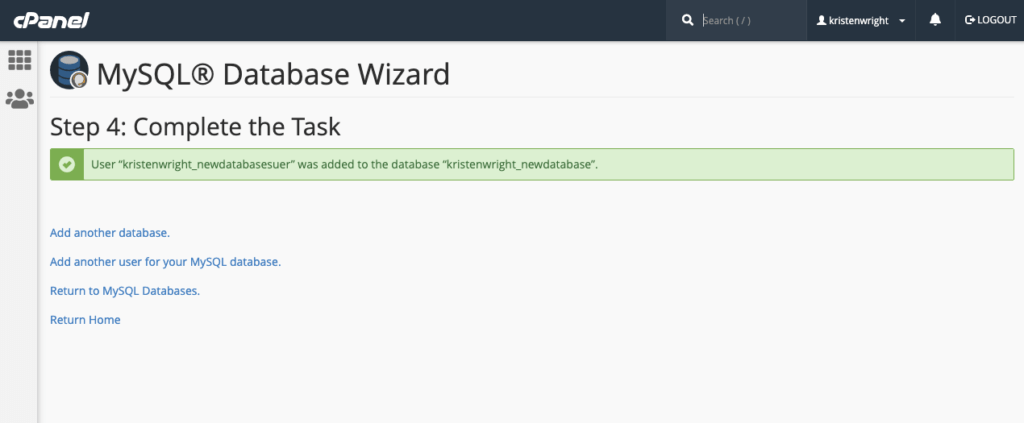
The terminal screen confirms the creation of the new database and the new user.
Using phpMyAdmin To Create the MySQL WordPress Database
Log in to the phpMyAdmin interface every bit described in the "phpMyAdmin Login" section above. Once y'all're logged in, find and click on the Database tab.

You'll desire to specify a name for your database in the "Create New Database Input" file. Click on the button that says "Create."

Now that the database is created, it'southward time to fix upwardly a new user to access information technology. To practise this, yous'll want to navigate to the tab that says "Privileges" and click on "Add New User." On the "Add New User" page, enter a new username, host and password. You can ignore the other fields.
If you lot're installing WordPress on the aforementioned server as MySQL is hosted, (this is the nigh typical scenario) gear up the host to Localhost. What this means is that the user will always connect from the same host computer. Whatever requests using credentials from remote servers will be immediately denied.
In one case you've created the new user, from the "Privileges" tab click "Edit Privileges" for the new user. Curl downwards to the privileges section that is specific to the database and assign user privileges to merely the newly created WordPress database. You'll be able to select the database from a driblet-down menu.
After you choose the new database, you'll be redirected to a page where you'll specify the specific user privileges for information technology. When you're installing WordPress, information technology's safe to assign a user all privileges except authoritative, unless yous're comfortable with the new user having administrative privileges likewise.
Using the Command Line To Create the MySQL WordPress Database
If you want to create your database without using phpMyAdmin, you tin can use command line.
At the command line, log into MySQL every bit the root user.
>mysql -u root -p Enter password: ********
Once your password is specified, you'll get connected directly to the MySQL database. You should now be at a MySQL prompt that looks very like to this:
mysql>
To create a new MySQL database, issue the following control, wheredatabase_name is the name of the database you want to create:
CREATE DATABASE database_name;
One time you've created the database, you'll want to create a new users. For your database named database_name, let's say the new username is junglechild and you lot want to prepare the password to rX3V79#due east^!) specifically.
In this case, the full command to type in would be:
GRANT ALL PRIVILEGES ON T8967RRT.* TO "junglechild"@"localhost" IDENTIFIED BY "rX3V79#due east^!)"
Once you've created the new user and privileges are assigned, you'll desire to run the command FLUSH PRIVILEGES to flush out all quondam privileges and starting time using the newly assigned ones.
Recommended Permissions for the WordPress Database
For standard WordPress operation, the database user needs only SELECT, INSERT and UPDATE privileges. Information technology'due south highly recommended to utilise the accented minimum of privileges when you're running a WordPress database.
Additional privileges similar CREATE, Change and DROP tin can occasionally exist needed during major upgrades. They can also exist needed when plugins are installed that need to change the structure of your database in gild to office on your website.
In cases like this, the plugin developer will advise y'all that such changes are required to the user privileges of your database.
MySQL Queries
A lot of MySQL queries related to the database volition run automatically. However, you likewise have the ability to directly access the database and run commands and queries past paw. A database manager helps you simplify the process.
Let's have a expect at a relatively straightforward instance of a MySQL query:
DELETE FROM wp_comments WHERE wp_comments.comment_approved = 'spam'
This query will inform the database to look at all data related to comments fabricated past users. It'll notice and delete all comments that you've already marked every bit spam.
By conducting queries by manus, you tin can better attain certain tasks that you can't practise from the dashboard. You can do things such as changing the username on your business relationship, which the dashboard doesn't let.
How Do I Reset My WordPress Database?
There may be times when you lot want to reset your database to the original settings. For case, if you're working on a test site or local server, y'all might want to restore the database back to how it was earlier you lot made changes.
Resetting your WordPress database can exist washed with only a couple of clicks.
If yous don't want to create a backup copy of the unabridged site, yous can create a backup of just the WordPress database. More on this farther below.
To reset the database to its default settings, you'll first need to install and activate the plugin chosen WP Database Reset.
In one case the plugin is activated, get to the folio Tools > Database. From this location, y'all can click to select the tables you wish to reset. If yous want to reset all of the tables in the database, click on "Select All Tables."
If you select all tables, you'll exist given the option to reactivate your active plugins and the electric current theme. The plugin also preserves your active WordPress user account.
After this, the reset will need to be confirmed by entering a security lawmaking in the required text box and clicking on the "Reset Tables" link. When the alert popup appears on your screen, click OK to go along.
The plugin then proceeds to delete all of the information in your database tables. When the process is consummate, yous'll notice a "success" message on the settings page of the plugin.
After several moments, you'll be automatically logged out of your admin area in WordPress. At this point, you tin can log in over again using the same business relationship. Your database has been reset and the way your website at present appears will reflect this when you refresh it.
How Do I Repair My WordPress Database?
If y'all'd like to repair your database rather than reset it completely, the first affair to do is open your WordPress host'due south command panel surface area and log into your account.
Once you're in, you'll come across all of the options that your host provides you with inside of the control console. Detect the phpMyAdmin icon like you did earlier in the commodity and click on it.
For most host's control panels, you'll be able to find phpMyAdmin under a header that says "Databases."
Once yous're inside of the phpMyAdmin interface, you'll want to select "Correct WordPress Database."
Upon doing this, you'll run into that all of your internal folders volition appear within the sidebar. All of the folder names volition begin with wp_.
If you have more than than i WordPress site on the server, you'll see all of them when you select "Right WordPress Database." Double-cheque that the right database has been selected before proceeding any further with the repair.
Once the correct database has been opened, make sure that every role of the database gets repaired (unless, of form, the error message you received told you that only 1 specific function of the database was corrupt).
To repair all parts of the WordPress database, head to the bottom and select "Check All" within the chief directory. This highlights all subdirectories inside the database.
Later on you meet that all subdirectories are selected, open up up the list that'due south next to the "Check All" field.
Select the option that says "Repair Table."
Later the procedure runs, check to run into that it worked on the repair results screen. At that place, information technology will tell you lot if the repair was successful.
How Exercise I Optimize My WordPress Database?
With time and use, WordPress databases can become corrupted or need good overall housekeeping. This is where database optimization steps in.
You should optimize your WordPress database on a regular basis to keep information technology clean and functioning at its all-time. Without regular optimization, yous'll find that your WordPress site speed will boring down over time. WordPress database optimization is a relatively simple process with a couple of dissimilar ways of getting it done.
Easy WordPress Database Optimization with iThemes Sync
iThemes Sync is smashing tool to help yous manage multiple WordPress sites. Within the iThemes Sync dashboard, you can perform several database optimizations all at once, for all your WordPress sites.

Here are a few of the WordPress database optimizations performed by iThemes Sync. You can select all of these to run and iThemes Sync will go to work deleting the unnecessary bloat from your website.
- Delete Trackback URLs – Deletes URLs added to the "pinged" and "to_ping" columns in your posts table.
- Delete All Revisions – Deletes all revisions from posts, pages, and all other mail service-types.
- Delete All Trackbacks – Deletes all trackbacks from other sites stored in your comments table.
- Delete All Pingbacks – Deletes all pingbacks from other sites stored in your comments table.
- Delete All Auto-Drafts – Deletes all auto-drats from posts, pages, and all other post-types.
- Delete All Trashed Items – Deletes all posts, pages, menus, and all other post-types that take been trashed merely not withal deleted.
- Delete Unapproved Comments – Deletes all comments waiting to be approved.
- Delete Trashed Comments – Deletes all trashed comments that have yet to be deleted.
- Delete Spam Comments – Deletes all comments that have been marked as spam.
- Delete Orphaned Commentmeta – Deletes all commentmeta that references a deleted comment.
- Delete Akismet Metadata – Deletes all metadata attached to comments by the Akismet plugin.
- Delete Stale Transient Options – Deletes all transient options that expired more than a week ago.
Optimize Database via phpMyAdmin
The first way of doing information technology is past logging back into phpMyAdmin and clicking on "Databases." Hither, you'll run into listed the database you desire to optimize. Once again, you'll come across all of the tables related to your website database.
From in that location, all you lot need to practice is scroll downwards the page and click on "Check All." Then navigate to the "With Selected" drop-downwardly menu and cull "Optimize Tables."

The organization now optimizes all of your selected tables.
WordPress Plugins for Database Optimization
If y'all'd rather optimize your WordPress database with a plugin, in that location are a couple of unlike ones that you can use. This may exist a more comfy option for you if you're not excited about poking around in the database manually.
The start one is called WP-Optimize and tin can be found on the WordPress plugin repository.
This plugin is simple to install and operate for nearly anyone that manages a WordPress database. You can likewise use it to schedule an automated optimization at whatsoever time of the day or nighttime.
How Do I Fill-in My WordPress Database?
We strongly recommended (and we exercise mean strongly) that you always backup your WordPress database at regular standard intervals (once per calendar month is a good idea) with a reliable WordPress backup plugin similar BackupBuddy. (Here are some more than tips on WordPress fill-in schedules.)
Nosotros especially recommend that you backup your databases prior to performing site upgrades or even optimizations. This fashion, if something goes wrong, y'all'll be able to restore the database (and your website) without whatsoever panic.
The Easy Way: Database Backup with BackupBuddy
Past far the easiest manner to backup your WordPress database is by using the WordPress backup plugin, BackupBuddy. BackupBuddy allows y'all to easily fill-in, restore and migrate your WordPress website to a new server or domain name.
After you lot download and install the BackupBuddy plugin, it will take you step-past-footstep through the procedure of backing up your site and database in a way that whatsoever novice can hands empathize.
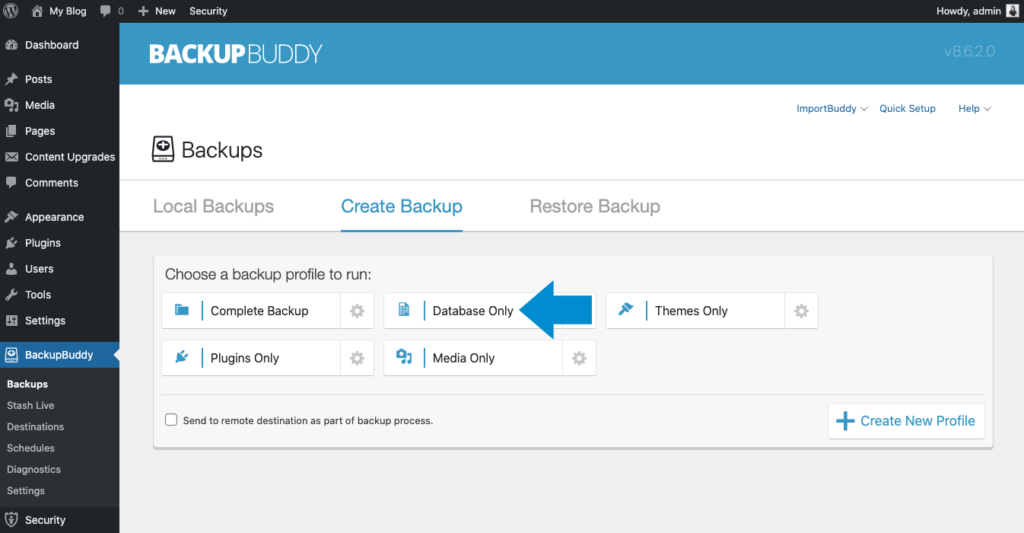
BackupBuddy is a powerful plugin that's perfectly suited for backing up your database on a regular ground. In fact, information technology performs 5 types of WordPress backups.

The Manual Method: Database Backup Via phpMyAdmin
Simply if you lot'd rather tackle the job manually, you tin do that every bit well. The first affair to practise is to log into phpMyAdmin on your server. From the window on the left side of your screen, select the WordPress database that you desire to backup.
The window on the right side volition brandish all tables that are inside the WordPress database. You'll want to click on the "Consign" tab on the top set of tabs.

Select the Quick option and so click on "Go." Y'all'll then go a prompt asking yous to download a file.
Salvage this file to your computer. If the database is large, the download may take a few moments.
Y'all can also choose the Custom fill-in option if you desire to change the default beliefs. In the above pace, choose the "Custom" option instead of the "Quick" option. From at that place, you'll see detailed options displayed.
The Table section is where you can select from all of the different tables in the database. If other programs are using the database, choose only the tables that correspond with your install of WordPress. They'll be the ones starting with "wp_" or a "table_prefix" yous already specified inside your "wp-config.php" file.
If y'all only accept WordPress installed, leave equally is or click on "Select All" if the selection was changed. In the Output section, select "gzipped" or "zipped" from the Compression box. This will allow yous to compress the data when you download information technology.
In the Format section, make sure to select SQL. This will export a sequence of SQL commands rather than other data formats such as CSV, which wouldn't work for this fill-in process. When you see the Format-specific section, get ahead and leave things exactly as they are.
In the Object creation section, select the following:
- Drib Tabular array
- View
- Procedure
- Office
- Result
- Trigger
Prior to the creation of the target database, it'll call a DROP statement that deletes any sometime existing tables if they exist. After this, you'll want to brand sure to get out the Data cosmos options section exactly as they already are.
Head to the bottom of the window and click "Go." You lot'll be prompted to download a file. Salve this file on your computer. Keep in heed that this process does non support all your files and folders (similar images). However, all of the things like blog posts and user comments accept been backed up with this manual database fill-in process.
How Do I Restore My WordPress Database?
Hopefully, you'll never demand to restore your WordPress database, but if you do, there are a few ways to do then.
Using BackupBuddy to Restore Your WordPress Database
Hopefully, you've already downloaded and installed the BackupBuddy plugin to backup your WordPress database. If you lot've washed that, restoring your database can be performed within the plugin.

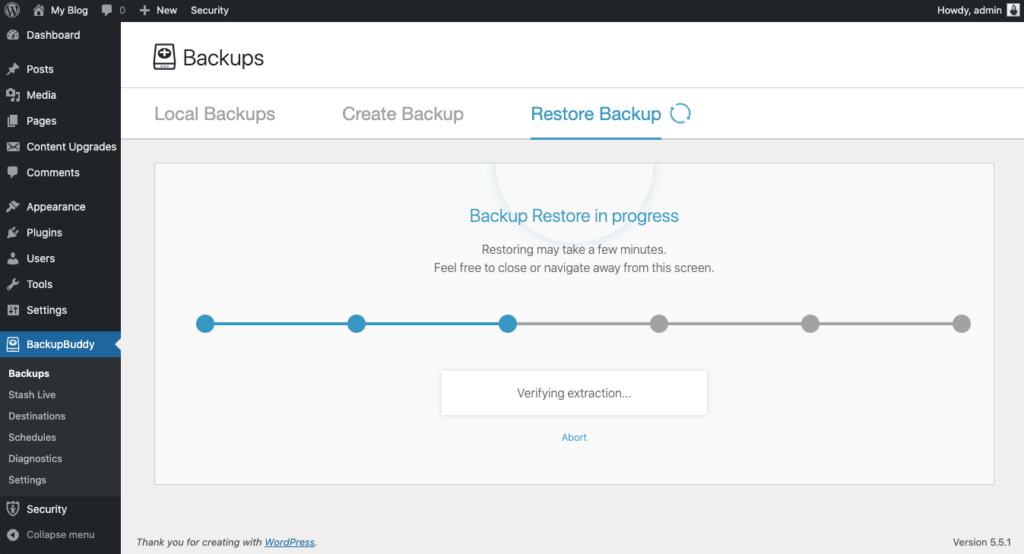
Navigate to the Backups folio within the plugin and and then the Restore Backup tab. Use the button to the correct of the Database backup to restore your database.
You lot can so watch BackupBuddy restore the database to the version contained within the backup.
Restoring via phpMyAdmin
If you'd like to take the more than difficult route, you can again use phpMyAdmin (are you seeing a trend here between phpMyAdmin and your WordPress database?) to achieve the task.

Here are the steps to take:
- Login to the phpMyAdmin platform.
- Click on "Databases" and select the database you'll be importing information into.
- You'll see either a screen telling yous that no tables exist or a list of tables that are already inside the database. This volition depend on how you lot have things set up.
- Click on the "Import" tab nearly the top of your screen.
- On this screen, click on "Browse" to detect the database backup file that you stored on your computer.
- Double cheque that SQL is selected in the drib-down menu titled "Format."
- Click "Get."
At present feel free to take hold of a coffee or a hot tea because this volition take a while. When the procedure is complete you lot'll run across a screen proclaiming success.
Wrapping Up: The WordPress Database Explained
Although you may not have been aware, your WordPress site is much more complicated than information technology appears. In that location'due south a ton happening behind the scenes that makes WordPress function the way it does. This is true for all WordPress sites, whether they're large corporate sites or tiny personal blogs.
Hopefully, you at present know a lot more than virtually the WordPress database, including how to create one, access it, repair information technology, back information technology up or optimize information technology like a professional.
Knowing this detailed information about the WordPress database puts you in a position of knowing a lot more than than most WordPress users. And while information technology may take a while to get comfy working with the WordPress database, you'll now be much more confident than yous were before.

Kristen has been writing tutorials to help WordPress users since 2011. As marketing director here at iThemes, she's dedicated to helping yous observe the best ways to build, manage, and maintain effective WordPress websites. Kristen also enjoys journaling (bank check out her side project, The Transformation Year!), hiking and camping, step aerobics, cooking, and daily adventures with her family, hoping to live a more present life.
villanvevawilien1959.blogspot.com
Source: https://ithemes.com/blog/wordpress-database-explained/
0 Response to "Triogger Wordpress to Upgrade Database Again"
Postar um comentário